Sunday, April 25, 2010

Colbert Makes the Connection: Arizona/Detroit

On Friday, Jan Brewer signed a bill into law that allows police to question "suspected illegal immigrants" for their papers, inspiring a great deal of furor among Tucsonans. It is a common first instinct for many of us recently-arrived young folks to say that it's time to leave when such things happen. But after years of thinking that Arizona's red politics (and its SOLE art house theater and its completely illogical tanning salons and its bleached blond sorority sisters and its 3% black population) would eventually prompt me to leave, I am starting to feel more aware of just how many people around here aren't as divorced from reality as our Martian-like politicians.

At the restaurant where I work, for example, my co-workers used their breaks from work to grab (free) "Legalize Arizona" tee shirts across the street at American Apparel, to the delight of our customers. And as I walked the dog yesterday morning, I listened to speeches at Congressman Raul Grijalva's headquarters against the Immigration Enforcement Bill, and felt a buzz in the air. Brewer's naive, bizarre step in the direction of fascism has, like any natural disaster, started to bring folks together:


While it's been my temptation to abandon this town, (and I am going to Detroit for a break soon, obviously) there is something satisfying about sticking around, and helping a new culture-- one that is compassionate, culturally diverse, and artistically dynamic-- manifest itself. I'm starting to consider being the antithesis of bi-coastal. Being bi-Tucson/Detroit-al. Spending time in two places that are becoming America's most unfortunate. I mean, c'mon, what's so great about having low self-esteem in Brooklyn when you can walk around knowing that you have more degrees than Arizona's governor?

That said, I can't blame people for wanting to escape racial profiling, deportation and a general air of harassment. But if everybody leaves, what will be left? Stephen Colbert likened the Arizona of the future to "a very dry Detroit." After all, it only took a couple of crooked politicians to help hurtle Detroit toward it's current state. One possible solution could be to give these tired Arizona politicians a chance to relax in one of the Sonoran desert's many spas while somebody else (as my friend Dallas has suggested, those "crystal-yoga women in Sam Hughes who walk their dogs at 4AM") tries to fix our dismal economic/educational situation. There are PLENTY of folks in Tucson who actually have a college degree, unlike Gov. Brewer.

Thursday, April 22, 2010

Saturday Night Movie at Shakespeare and Co.

This weekend, Detroit Ho! will host Saturday Night Movie at Shakespeare and Co. In addition to showing a documentary, we will be selling used books, handmade Detroit-themed posters, and freshly silk-screened tee-shirts.


Why "at Shakespeare and Co. Bookstore"?

OK. It's actually at Logan's house in Tucson. BUT, we can pretend. In 1919, Sylvia Beach started the Shakespeare and Company Bookstore in Paris, with the help of her girlfriend Adrienne. It became a base for English speaking writers like Ezra Pound, Ernest Hemingway and Gertrude Stein. Beach is perhaps best known because she took the risk to publish James Joyce's Ulysses, despite the fact that she had little experience as a publisher. Beach's store is a fantastic example of the Do-It-Yourself mentality embraced by Detroit Ho!... and of what our summer is going to look like! A handful of lesbians brainstorming on beg-bug-ridden couches. I am only kidding. There are no bed-bugs in Detroit.

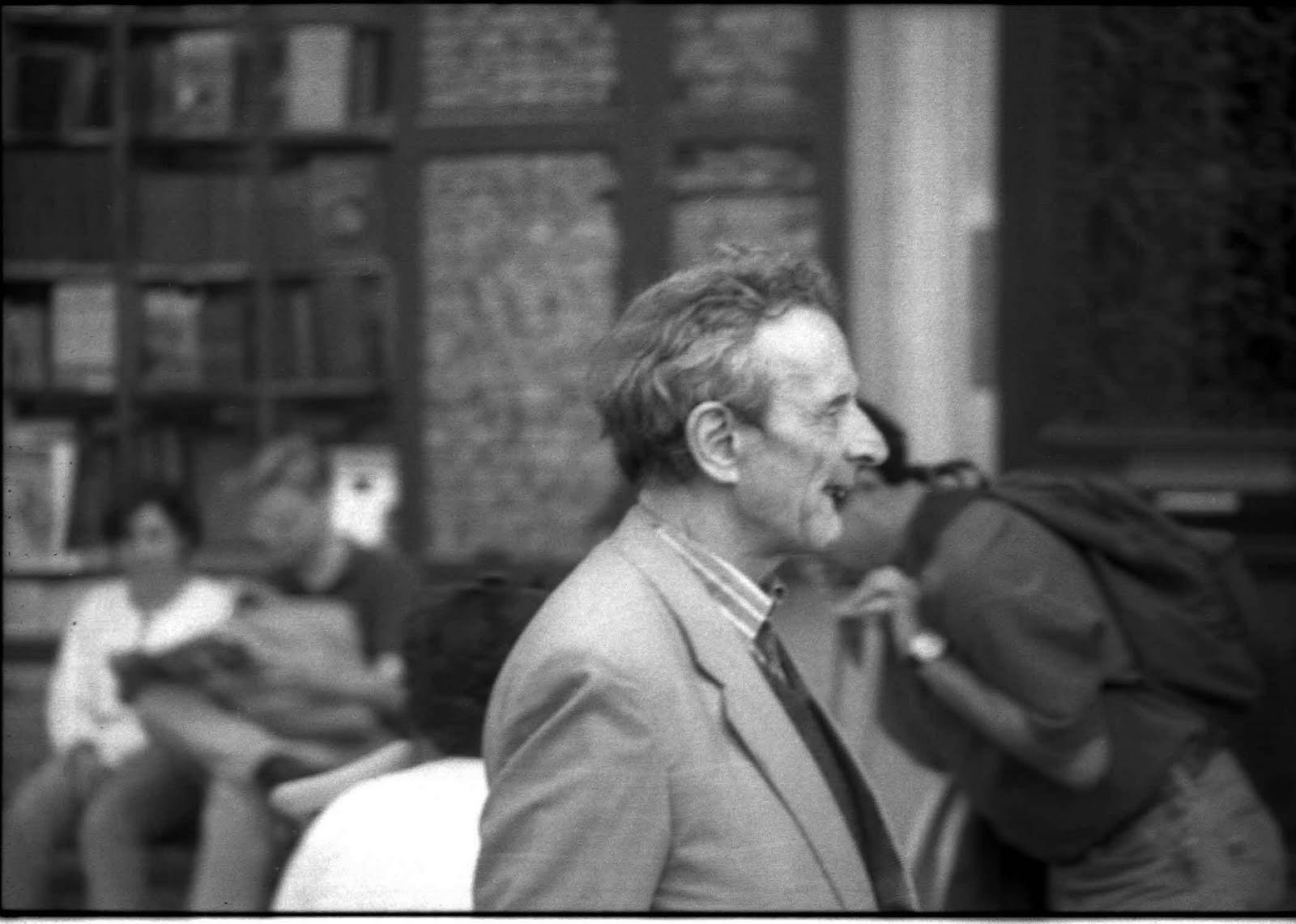
When I was sixteen, my dad and I spent the summer in Paris, and five days out of seven were spent at the Shakespeare bookstore. We sat upstairs listening to Mary Louise tell stories about raising her family in a tent in Italy as she puff-painted portraits of Shakespeare onto black tee-shirts. We ate Chinese food down the street with a group of ex-pats and listened to Finnish poetry. We tried time and time again to get the owner, George (featured topless below), to crack a smile. Artists and writers from all over the world exchanged a few hours at the register for a bed in the apartments above the store. It was one of the first artistic communities I witnessed, and one I'd very much like to emulate in Detroit this summer.

Here are some pictures from that trip (to be superimposed onto the images that come to mind when you think of Detroit):


Sunday, April 18, 2010

Tucson Artists!


On May 8th, Detroit Ho! is hosting an art auction: Detroit Summer Nights. There will be piano jazz, a trike raffle, and much much more. Perhaps you'd like to consider donating a piece of art to our fundraiser! Or you have an artist friend you'd like to tell. If so, contact Logan at airtrain@gmail.com or Aisha at sloanish@gmail.com. The deadline to donate is May 4th.

Monday, April 12, 2010

Interview: Marshall Walker Lee


At the Association of Writers and Writing Programs (AWP) conference in Denver this week, I ran into a bunch of former classmates from the University of Arizona MFA program. I spoke with one who heard of my interest in Detroit and referred me to speak with Marshall Walker Lee at the "Poor Claudia" literary journal table in the book fair. Among other things, Marshall grew up in Detroit, studied at the University of Michigan, worked for an arts organization in various rural locales in South Africa, and helped start a well-regarded literary journal in Portland, Oregon. Detroit Ho! recently decided to start interviewing people with expertise on Detroit and/or the process of establishing a creative community, and Marshall is our first "expert" in this series. Oh wait... I can't disregard Spike Lee... Marshall is the second expert. And the second Lee.


Detroit Ho!: What exactly is the arts scene in Detroit right now?

Marshall Walker Lee: One of my best friends in Detroit works for an organization called "Inside/Out," which is something that Detroit Public Schools (DPS) are doing to bring artists and writers into middle and high school classrooms. The literary and art scene has really taken off since the opening of Museum of Contemporary Art Detroit (MOCAD), which is in the shadow of the Detroit Institute of Arts (DIA). It's an artist run co-op with concerts and arts programming. When my older sister moved to Detroit after going to the University of Michigan, nobody from her class moved to Detroit. But when I graduated six or seven years later, around fifty people from my class ended up moving there. It is cheap to live there, and abandoned spaces make everything guerilla. There are huge non-profit grants to lure young white artists from the suburbs. Last year, there was a $25,000 grant for photography. This year it's for writing. Everybody is applying for it.

DH: Damn...


MWL:
Because it is dirt cheap you can do so much there with practically nothing. You can start a restaurant with a full liquor license for something like $60,000. But there is no infrastructure to maintain it. I love the idea of living there except for the winters. And there is always a necessity to drive. But the city attracts self-motivated artists who don't need to rely on an institution or school system to sustain them. I mean, Wayne State's radio station is shutting down. But twenty-five to thirty-year-olds work easily part time at a job, and part time at a non-profit or library program, with plenty of time to do their art. My friend's dating the co-director of the city's NPR station.

DH: How long has this all been going on?

MWL:
I think the city has been building toward a new beginning since the opening of the Renaissance Center in what, 1977? But they've been waiting for the right mayor and legislature to bring this about. It seems like Dave Bing may finally get things done. He is aiming to cut the footprint of the city in half. One of the best proposals being considered now is that they build a green belt around the city, but that probably won't pass. So they are trying to move one neighborhood at a time to the city-- which is what they have to do. And it's now or never. If the auto industry leaves completely, it'll be like Berlin in the 1980's. It will have to start over again.

DH: So what all is going on art-wise, specifically?

MWL:
My friends do something called "Theatre Bizarre." A bunch of artists go to the state fairgrounds, which have been abandoned. And for one night they turn on all the rides, and it's like Mardi Gras for one day. It's this burlesque carnival.

DH: What are your thoughts on gentrification as it relates to Detroit? Does it have to have the same effect as has been the case in Brooklyn and Portland?

MWL:
It's strange to say this about gentrification, but in Detroit the areas least gentrified are the ones shutting down completely. Because they are 50-70% unoccupied. In east Detroit, 20% of the areas are unoccupied and they've turned into an urban prairie land, which people are romanticizing. But there are wild dogs roaming around. You have to go out with a baseball bat.

DH: Tell me about the work you did in South Africa.

MWL:
Well, I'd gotten a grant to go there and write. And eventually I ended up doing work with this bookbinding press about 40 miles outside of Johannesburg. Between Durban and Johannesburg. The CreACTive Center. I worked with a woman named Gabisile Nkosi, who is a pretty famous South African artist who grew up in a township and really made herself. She built her own house and her life from just doing her art. But she was killed by her ex-husband. It was really horrible. She died just after I left.


She helped set up centers around the country in rural bush schools to teach classes to kids and adults in practical crafts. Things like teaching weaving to women, bookbinding for record keeping. It was part of Caversham Press, which was started under apartheid. It was the first printmaking press for both blacks and whites-- "open," they call it. Some major names in the South African art scene came out of there.

DH: What was it like?


MWL:
It was a positive experience for me because of who I was with.

DH: What exactly did you end up doing?


MWL:
I was able to teach and develop programming. They were a kind of medium for me to understand what was going on culturally. One thing we did was, if we were there for two or three days, we'd ask people to establish a community newspaper. They had to go home, write a story, and illustrate it. One kid went home and asked his grandmother for a story he didn't know. And she told him about the time his grandfather had beaten her so badly he broke her eye socket. When he came back and told us, all the other kids just nodded. I mean, every Saturday you go to funerals. There is something like a 90% AIDS rate in rural east South Africa. Johannesburg is kind of like Detroit in some ways.

DH: What you're saying reminds me of an NPR story I once heard about funerals being a kind of recreational activity in Detroit. That kind of culture of violence. What else do Detroit and Johannesburg have in common?


MWL:
They are both sparsely populated. Land laws are such that residences, businesses and factories can all be in the same place. But Johannesburg is also unique. It's the only major city with no body of water. It was built because of the gold deposits, and it has no sense of itself. It's much more violent. It's not really a city. I've heard that in the next 20 years, it will join with Pretoria to make a city of 55 million people.

DH: Where will Detroit be in 20 years?


MWL:
It's possible that it is going to die before it gets better. There is just such an endemic lack of government. So much corruption. It may have to fall apart. And perhaps young people might move there and form a resistance. Already, everyone under thirty living in Detroit is really involved in politics. Everyone knows the name of the president of the school board. You have to be involved or you'll feel powerless.

DH: So when did you start "Poor Claudia"?

MWL:
It's one year old.

DH: And you are a printmaker?


MWL:
No, both Drew (co-founder) and I are just lit nerds. I'm a writer. We just taught ourselves this stuff.


Marshall, Gabisile and the people/organizations he described are an excellent example of what my friend Daisy has deemed "Nouveau DIY:" a new phase in the era of "Do-it-Yourself." With a motivation that goes beyond redoing the living room... Watch out TLC.

For more info on Poor Claudia, check out this article from the Portland Mercury.

Saturday, April 3, 2010

Detroit Ho!'s Exclusive Interview with Director Spike Lee


OK. Maybe this isn't an exclusive interview. Maybe it's the "exchange" that took place between members of Detroit Ho! and Mr. Lee during his recent visit to the University of Arizona's Centennial Hall. But there was still a back and forth... Our dialogue began after a brief discussion of Mr. Lee's history as a film student, getting a student Academy Award at NYU, living without electricity in Fort Greene, failing at his first feature, and finally succeeding with (my personal favorite) "She's Gotta Have It." Here's the transcript:

Spike Lee: There was an audience for that kind of film... it was "She's Gotta Have It" along with "Hollywood Shuffle" by Robert Townsend. You should check it out if you haven't seen it. Those two films brought about the so-called "Black Renaissance" in film.

Detroit Ho [Aisha]: (Laughter...lone laughter).

SL: Why you laughin'? It was a big thing back then.

[time passes]


DH: I know New York is your city. And you've done some work in New Orleans. But, what would you do in Detroit?

SL: Ooooh. You from Motown?

DH: All my family is.

SL: The Motor City? You know, Detroit is really the most depressed city in the United States of America. There's definitely stories there. And uh, it wasn't once like that. We had the car industry there, uh, things went downhill after the riots. Your mayor... Kwame Whassisname?

DH [Miro]: Kilpatrick.

SL: That wasn't a good look. (Laughter). There definitely is... I'll bet you could do a good TV series, like a Detroit version of "The Wire." Also, all those fans of "The Wire," David Simon's next new show is called "Treme" and it's about New Orleans. But definitely, there's a lot of good stories in Detroit.

Thank you Mr. Lee. We look forward to our next interview...

Monday, March 22, 2010

Travels with Pen Reading Sunday


This summer, a group of artists, designers and writers are heading to Detroit for the First Annual Seminole Street Artist’s Colony and Exhibition. We plan to transform an historic house, with a literary past, into a residence for artists and writers—not unlike Casa Libre. Part of our mission is to disrupt the poor image that Detroit has earned, over time, as the nation’s failure—and in this spirit, our first Tucson event this spring will be an attempt to raise awareness about the ways in which we conceptualize of our environments: “Travels with Pen: Five Minute Sketches on Place.” Please join us! If you’d like to learn more about our endeavor, scroll down! We’ll be hosting various events, and an art auction/fundraiser in the coming months.

Here are some of the bios of writers participating... stay tuned as the list will grow!


Arianne Zwartjes' first book, The Surfacing of Excess, won Eastern Washington University's 2009 Blue Lynx Prize for Poetry and a box of copies just arrived at her house. Her 2008 chapbook of prose poems (Stiched) A Surface Opens: Essays was published by Diagram/New Michigan Press, and her writing has appeared in literary magazines including The Pinch, Cue, Caketrain, Front Porch, Diagram, Blue Fifth Review, and Word for/Word. Zwartjes teaches at the Poetry Center and in the English Department at the University of Arizona; she is also an EMT and wilderness medicine instructor, and has just completed a book-length collection of lyric essays entitled (Detailing Trauma).

Simmons B. Buntin is the founding editor of Terrain.org: A Journal of the Built & Natural Environments. His first book of poetry, Riverfall, was published in 2005 by Ireland's Salmon Poetry; his next collection, Bloom, is due from Salmon in late 2010. Recent work has appeared in Mid-American Review, Isotope, Orion, Hawk & Handsaw, and Southwestern American Literature. Look for new work in High Desert Journal, ISLE, Freshwater, Spiral Orb, Salamander, and Versal. Catch up with him at www.SimmonsBuntin.com.

Leftrick Herd had to leave Oregon one year after his birth because his parents feared he might be getting "webbed feet" from all the rain. He grew up on an 80-acre ranch in western Colorado where his main sources of transportation were horses and an old Willy's Jeep. Joining the Navy only whetted his appetite for adventure and he has been on some sort of trip ever since.

Ben Quick
served as Beverly Rodgers Fellow in creative nonfiction on his way to a master of fine arts degree from the University of Arizona in 2008. He lives with his son in Tucson where he writes and teaches at the U of A. The recipient of a 2010 Pushcart Prize for Nonfiction, his work appears in Orion Magazine, Hotel Amerika, Terrain.org: A Journal of the Built and Natural Environments and other publications. He smokes. And he likes it. Especially after coffee, sex, food, exercise and any combination thereof. He doesn't like lectures. He will live to be 100.

Beth Alvarado, who has lived in Tucson since 1968, loves the desert and often writes about it. Her stories are collected in Not a Matter of Love (New Rivers Press). Newer work has been published recently in Seattle Review, Ploughshares, Cimarron Review, and Third Coast.

Timoteio Padilla is a universal artist who is not from one particular place. He is of the stars, and the red dirt, and all the elements. He is here and he is there. He was physically conceived in this plane in New Mexico, and was raised in Tucson. He is an artist who utilizes the medium of Hip-Hop, and lives what he speaks.

Lauryn Bianco
would live her life to a soundtrack of music from the 70's and 90's if it were possible. This bio, in fact, should be read to the tune of Salt-n-Pepa's "Shoop" or any track recorded by TLC. Lauryn once ran a half marathon while wearing a tiara and hoop earrings. She has since completed a full marathon, and she no doubt will run her next one backwards and in heels. Lauryn is from New York, which you might not notice until she gets angry or drives. Lauryn has a BA in English from SUNY Fredonia, a master's degree in Gender and Women's studies from the U of A, and a black belt in femme fatale from an undisclosed credentialing agency.

TC Tolbert is a genderqueer, feminist poet and teacher committed to social justice. S/he earned his MFA in Poetry from UA in 2005 and currently teaches Composition at Pima Community College. TC is the Assistant Director of Casa Libre en la Solana and is a member of Movement Salon, a compositional improvisation group in Tucson. S/he is a collective member of Read Between the Bars, a books-to-prisoners program, and s/he spends his summers leading wilderness trips for Outward Bound. TC's poems can be found in Volt, The Pinch, Drunken Boat, Shampoo, A Trunk of Delirium, and jubilat.

Daisy Pitkin lives in Arizona, grew up on a farm in Ohio, and at fourteen coerced her friends to read "A Midsummer Night's Dream" and "The Tempest" on a roof. Her job as a union organizer kept her moving around the world, and for ten years she rarely spent more than five days in the same place. Her most recent nonfiction manuscript contemplates themes of memory, maps and family.

Lisa O'Neill is a writer, teacher of writers, and a graduate of the University of Arizona's program in Nonfiction Creative Writing. In addition to teaching students pursuing undergraduate degrees, she co-teaches writing workshops with incarcerated writers in Pima County, Arizona through the program Inside/Out. Although she lives in Tucson, Lisa often centers her writing on the place where she grew up and the geography closest to the heart, Louisiana. She recently completed a nonfiction manuscript, Vessels, which explores the physical, cultural and historical landscapes of her home state as well as her home town, New Orleans. Lisa appreciates people who experiment and play with sound, language, color, texture and light in whatever form this play takes.

Manuel Munoz is the author of the short story collections Zigzagger and The Faith Healer of Olive Avenue. He has received numerous honors, including the 2008 Whiting Writer's Award, a 2009 PEN/O. Henry Award, and a National Endowment for the Arts fellowship. A graduate of Harvard University and Cornell, his writing has appeared in the New York Times, Rush Hour, Swink, Epoch, Glimmer Train and on NPR. He teaches creative writing at the University of Arizona.

Gillian Drummond is a Tucson-based freelance writer. Her articles appear every Sunday in the Arizona Daily Star and on her blog, www.homeisafourletterword.com. Gillian came to Tucson in 1998 from London, where she had spent nine years working on business and consumer magazines, and freelancing for national newspapers. Her credits include The Guardian, The Scotsman, The Daily Telegraph and Sunday Times Scotland. She is working on her first novel.

Cesar Diaz lived the fragmented life of a migrant boy: divided. conflicted. uprooted. in-between. in constant argument. unforgiving and in a bind. His work is not a figment of his imagination but a construction of the imagination of a boy (now a man) who uses language, memory, and his own words as a glue to understand the situation he was in. Cesar Diaz is a writer. A journeyman. An essayist with an urge to work with language as a method of searching. He strongly believes in the power that writing has on youth and has worked as a creative writing teacher and mentor for outreach nonprofits such as Badgerdog Literary Publishing, Breakthrough Collaborative, The Austin Academy and The GEARUP project. He is a second-year MFA candidate in nonfiction at the University of Arizona, and hopes that some of his journeys find their way into a literary magazine. In the meantime, he'll settle for introducing undergrads to the power and fecundity found in essays.

Ruth Hillman is a third generation Tucsonan and has been a semi-secret writer and artist since the fourth grade. She has worked to help people most at risk or living with HIV/AIDS for the last eight years and is starting a soon-t0-be famed new business, The Paper Theory.

Lucy Simpson grew up in East Yorkshire and Buckinghamshire, England. Since then she has lived in Paris, Geneva, New York City, Long Island, Dayton, Ohio, Charleston, SC and lately, Tucson, where she intends to stay awhile because moving is hard work and Tucson is nice and warm and slightly weird, which is good. Lucy has a degree in French from the College of Charleston and an MFA in Fiction from the University of Arizona. She is currently working on final revisions of her first novel, and teaching English at Pima Community College. The glamor and mystery just never stop. Lucy lives with two unruly stray children, three beautiful, inspiring, talented dogs, one cute fluffy husband and a wonderful, gruffly sexy, supportive hamster.

Remember! Casa Libre, Sunday March 28th at 4pm.


Tuesday, March 9, 2010

Travels with Pen: Five Minute Sketches on Place


In order to start generating awareness about The First Annual Seminole Street Artist's Colony and Exhibition, Detroit Ho! is going to host a few Tucson events this Spring.

The first will be a literary reading at Casa Libre on Sunday, March 28th at 4pm. "Travels with Pen: Five Minute Sketches on Place" will feature a collection of readings that delve into the nuances of the relationships we form with a particular environment. The goal is to spark thought on how we shape and are shaped by the places we inhabit. I'll post a list of readers soon! Stay tuned...